
Meditation Guides to download, meditative music, video and audio meditations and more resources and materials from these Course are available here. Some information here is very ‘advanced’, so you should ensure you have completed the whole course and are regularly meditating so you can appreciate the information. Please don’t hesitate to ask questions about the material via our WhatsApp groups. 🌹 SETUP A MEDITATION ALTAR IN YOUR HOME Having this simple and beautiful setup at your home will not only help you get into the practice of meditation, but will also create a positive balance and energy in your home. Try it yourself and see the difference… 🌹 USING SHRI MATAJI’S PHOTOGRAPH FOR MEDITATION If you wish to use Shri Mataji’s photograph, then it’s best to place the photo in a frame and use a small candle in front of the photo when meditating. You can download Shri Mataji’s photos from the section below “RESOURCES – Shri Mataji’s Photos for Meditation” or contact us at [email protected] Use this Guide to learn simple meditation and balancing techniques to help you experience the peace of true meditation. If this is your first meditation, then please follow the ‘Affirmation for Meditation’ steps for your Self-Realisation to activate your inner-being. Our Subtle System consists of 3 Channels and 7 main Chakras. The right and left channels are the physical support of our sympathetic nervous system and the central channel is the physical support of our parasympathetic nervous system. Energy Centres – the Chakras: Energy Channels – the Nadis: By regular practice of Sahaja Yoga meditation, you obtain the knowledge of your chakras, how to improve and look after them, in a very natural and spontaneous way. Your innate qualities start to manifest themselves. You can feel the state of your subtle system and by using simple techniques, you can maintain it in a balanced state. We give guidelines of these techniques in our weekly classes in your local area. They are always free. Find free classes in your country. Self-Realisation Out of all the energies that sustain us, there is one which is the mother of all other energies. This dormant is of a spiritual nature. It manifests the love that the Divine has for us. It is called Kundalini and she exists within everyone as a great potential of inner wellbeing. This living energy is waiting to reveal itself to us. Sahaja Yoga meditation starts with the natural awakening of this energy. The spiritual energy that is within us is called Kundalini. The Kundalini resides in the sacrum bone. This is the triangular bone which is located at the base of the spinal column. When this energy awakens, it activates the central channel and passes through the chakras to come out and can be perceived as a flood, gush, spurt (of coolness) in the fontanelle bone area. Once this energy has been awakened we can perceive its manifestation in a concrete way. A new state of awareness is established within us. Self-Realisation – the Awakening of the Kundalini mother energy. As soon as we have felt the condition of our chakras, we can improve them. We have the tools to progress easily with discrimination in our spiritual evolution. The Kundalini awakening is an indisputable discovery. For the first time, we have the chance to change ourselves and become independent. Introduction to the three channels of our Subtle System by Shri Mataji. Selection of videos about Sahaja Yoga meditation and its many techniques to assist with balancing and clearing the subtle system to ensure peaceful and joyful meditations free from thoughts. ‘Footsoaking’ is a clearing technique to bring balance to your inner subtle system and energy centres. Please have the items below available so you can participate in Footsoaking sessions: Items required: Footsoak treatment The Candle treatment is used to clear our ‘left channel’ of imbalances. As a safety precaution, do not do this treatment if you are wearing loose clothes or near any combustible materials. Take great care. You can sit on a chair or the floor for this session. Please have the items below available so you can participate in the Candle Treatment session: The Hamsa chakra, which is part of the Vishuddhi and represented by Canada, is situated between the eyebrows, and has the qualities discretion and discrimination; It’s also called the Lambica chakra. Treatment for the Hamsa is to put a few drops of slightly warm melted purified butter (Ghee) with a dropper into your nose and sniff it up. It avoids dryness of the inner lining. Apply it at night before sleeping. Affirmation to clear and strengthen the Hamsa is: “Shri Mataji, by Your Grace, please give me the power of discrimination.” Shri Mataji talks about the Hamsa Chakra Advice from Shri Mataji about the Hamsa Chakra “Now, how can we improve our Hamsa then? It’s a big problem, because if our Hamsa is sick, is over-conditioned. The Kundalini cannot work on it; it just gives up. Now, so for Hamsa we use all these physical things. Like I said, put the ghee in the nose. Keep it in a way that it is nourished properly. Because Kundalini, if it tries to too much attack the Hamsa, it will have a problem. Problem because, as it is most of our time we spend in such a manner that your Hamsa things become – what you call the epithelial cells, the linings – become dried out. When the Kundalini rises, She may try to create a problem more for that dryness – maybe. So it is kept out, but it has an effect in the sense that even if there is a light outside, it can fall inside.” “So it’s not the Kundalini directly that affects your Hamsa. It is like when the Kundalini awakens, you yourself see now that a person is, whether he is fair complexion or dark complexion, he is a human being. You reason it out and Hamsa clears up. Then you see yourself that, “Oh, I’m very egoistical.” You start seeing yourself through your Agnya, start seeing that, “I’m so conditioned.” So you reason it out, and that’s how you correct your conditionings. This is what is Hamsa chakra.” Selection of videos by Shri Mataji on her teachings about Sahaja Yoga, Self Realisation, meditations, the subtle system, chakras and other spiritual matters. We have found that by meditating in front of Shri Mataji’s photographs, our Subtle system comes into balance and is cleared through the positive vibrations that are emitted from her photographs. As a result, we become more relaxed and calmer as we experience the inner joy of the Spirit in our heart. We follow the traditional respect and protocol of not placing our feet pointing towards the meditation table and meditate with shoes removed. We can sit on a chair or floor, whichever is the most comfortable. If you wish to use Shri Mataji’s photograph, then it’s best to place the photo in a frame and use a small candle in front of the photo when meditating. Please contact us if you’d like us to email you other photos of Shri Mataji (in different sizes) for your meditation at [email protected] All images are in jpg format and are ready for printing. For best print quality, use a high resolution printer or take the files, on a USB stick, to a digital photo lab for printing. Image sizes available How to download: To download an image, right-click on the ‘Download’ link and save the file to your computer or device. Short video of Shri Mataji explaining why we use her photograph for meditation. This Meditation Card contains general instructions on how to meditate with a photo of Shri Mataji and the Affirmations exercise. “From Mantra to Silence” Booklet This booklet will help you learn more about the subtle system and how affirmations and mantras can strengthen your meditation experience. Learn how to further enlighten your own inner system; how to identify and clear your subtle blockages; and how to deepen and enjoy the silence of thoughtless awareness.
Resources - Meditation guides, music, videos and audios

Materials Required
We have found that by meditating in front of Shri Mataji’s photographs, our Subtle system comes into balance and is cleared through the positive vibrations that are emitted from her photographs. As a result, we become more relaxed and calmer as we experience the inner joy of the Spirit in our heart. We follow the traditional respect and protocol of not placing our feet pointing towards the meditation table and meditate with shoes removed. We can sit on a chair or floor, whichever is the most comfortable.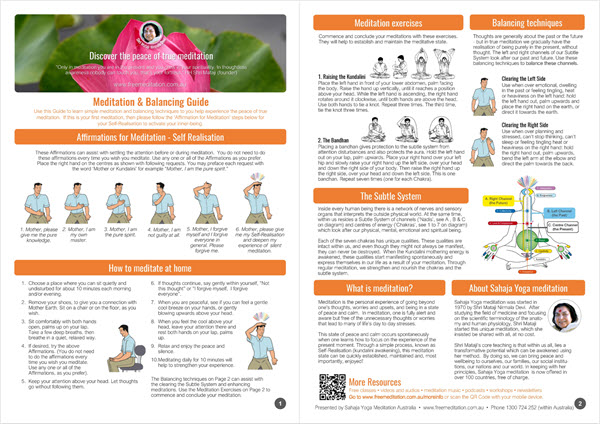
The Subtle System


Videos


How to prepare for the Footsoaking

(We’ll show you how to do this treatment during the webcast.)How to prepare for the Candle Treatment
 Candle treatment
(We’ll show you how to do this treatment during the webcast session.)


“It is, you know, placed between the two eyebrows and two eyes represent the left and the right side. So this centre is very much guided by our eyes, by our ears, by our nose, tongue, teeth, throat. Is a very important centre because the Vishuddhi, which has to look after sixteen petals, which, sixteen petals, which look after all these ear, nose, throat, different, different organs within us, also it has to communicate with the Viraat. So it has to pass through this centre of Hamsa Chakra. Hamsa Chakra is the very pivotal centre, which expresses auspiciousness in our awareness. That means, if this centre is alert and awakened, then we immediately know what is auspicious and what is not auspicious, or we can call it, we get the Divine Discretion… the light of the Spirit, which shines through your Hamsa Chakra, gives you wisdom. Wisdom doesn’t mean that you know how to argue things or you fight with people. No, it doesn’t mean that! Wisdom means how you take to the good side of everything, to enjoy it, this is Wisdom. And that you avoid all destructive things and take to something constructive.” (1992/09/13)
Using Shri Mataji’s photograph for meditation
Meditation Photos
Using Shri Mataji’s Photograph
Meditation Card
Teest
RESOURCES - How to Meditate at Home
RESOURCES - Meditation & Balancing Guide
RESOURCES - The Human Subtle System with its Chakras and Nadis
RESOURCES VIDEOS - Clearing, balancing and meditation techniques
Self Realisation, Balancing, Kundalini and Bandhan with Shri Mataji Sahaja Yoga
Shri Mataji guides you through your Self Realisation. She founded of Sahaja Yoga Meditation in 1970.
Afterwards, Shri Mataji will show you how to raise your own Kundalini and put on a Bandhan, to ...
Self Realisation and Balancing (6mins) | With Shri Mataji - founder of Sahaja Yoga Meditation
Shri Mataji will guide you through your Self Realisation and how to balance your inner being.
Self Realisation is the spiritual process of awakening the Kundalini within an individual. Everyone ha...
Raising Kundalini and Putting on a Bandhan (4mins) | Shri Mataji - Founder of Sahaja Yoga Meditation
After we receive our Self Realisation in Sahaja Yoga, we raise our Kundalini and put ourselves into Bandhan before and after meditating.
Shri Mataji guides us on how to do these two important exe...
Raising the Kundalini and Putting on a Bandhan (3mins) | With a Sahaja Yogi
After we receive our Self Realisation in Sahaja Yoga, we raise our Kundalini and put ourselves into Bandhan before and after meditating.
These exercises will help to establish and maintain a medi...
Fun with Footsoaking (6mins 30secs) | Sahaja Yoga Meditation
Footsoaking is a very powerful cleansing and balancing technique used in Sahaja Yoga meditation. It is used to dramatically improve meditation and reduce stress and anxiety.
We hope you enjoy this...
ILLUSION & REALITY | Meditation and live music
Sometimes, the illusion of our mind, and ideas of how things should be, can cause frustrations.
Through meditation, we can surrender to new ideas to overcome these frustrations by going beyond the...
How to setup for Meditation at home
🌹 SETUP A MEDITATION ALTAR IN YOUR HOME
Materials Required
- Shri Mataji's photograph in a frame (recommended natural material)
- Candle and candle stand
- A clean pedestal or table for the photogr...
Let's Meditate for 21 Days | Day 21 "Hello Everyone!" 20th August 2021
Saturday 21st August 2021 | DAY 22: Clearing, Balancing and Meditation Workshop for Regulars and Newcomers.
We invite to our online workshop where you will have the opportunity to interact with an...
RESOURCES - Preparing for Footsoaking and Candle Clearing Treatments
RESOURCES - The Hamsa Chakra
RESOURCES VIDEOS: Shri Mataji's Talks and Videos
1
/
2
Knowledge of our Roots - Shri Mataji Talk Excerpt | Public Program Brisbane 1987
Shri Mataji explains the knowledge of our roots and Kundalini energy which resides within every human being in the triangular bone called Sacrum. Kundalini energy can be awakened in a simple and ri...
Introduction to the 3 channels of our Subtle System by Shri Mataji, founder of Sahaja Yoga.
Introduction to the three channels of our Subtle System by Shri Mataji, founder of Sahaja Yoga Meditation.
Free Meditation Classes available in over 100 countries
https://www.freemeditation.com.a...
Shri Mataji gives Self Realisation (with Subtitles and Sitar Music)
Shri Mataji gives Self Realisation - Brisbane Public program Brisbane City Hall (Australia) 5th May 1987
Self Realisation is the process of awakening the Kundalini within an individual. Everyone ...
Raising Kundalini and Putting on a Bandhan (4mins) | Shri Mataji - Founder of Sahaja Yoga Meditation
After we receive our Self Realisation in Sahaja Yoga, we raise our Kundalini and put ourselves into Bandhan before and after meditating.
Shri Mataji guides us on how to do these two important exe...
Powers of a Realised Soul | Shri Mataji's Talk Excerpt
An introductory talk by Shri Mataji Nirmala Devi about the powers of a Self-realised person.
1987, Brisbane, Australia.
Importance of Meditation & Footsoaking explained by Shri Mataji (Founder of Sahaja Yoga Meditation)
Shri Mataji explains the importance of meditating and foot soaking daily and how it helps with our spiritual growth.
8 Minute Meditation - With music and mantras
Short meditation with instructions and music. The beautiful music and mantras will help clear the chakras and thoughts, for a more peaceful and quiet meditation.
Place hands on lap (palms up), then...
Mooladhara and Swadhishthana Chakra Introduction by Shri Mataji
Shri Mataji Nirmala Devi (Founder of Sahaja Yoga Meditation) introduces in brief the first two energy centers, Mooladhara and Swadhishthana Chakra.
Mooladhara Chakra: Center of Purity, Wisdom, Inn...
Center of Creativity & Pure Knowledge - Swadhishthan Chakra | Shri Mataji's Talk
Swadhishthan Chakra - Talk by Shri Mataji Nirmala Devi (founder of Sahaja Yoga Meditation).
Birmingham Jul 10th 1982
Talk on Nabhi Chakra by Shri Mataji
Sahaja Yoga Meditation
#shrimataji
Talk on Heart and Vishuddhi Chakra by Shri Mataji
Sahaja Yoga Meditation
#shrimataji
The Real Yoga Shri Mataji Nirmala Devi
Real Yoga is the spiritual union attained through Self Realisation and Meditation.
“So this is your birthright. All human beings have this right to get the awakening of their Kundalini by which th...
Self Realisation, Balancing, Kundalini and Bandhan with Shri Mataji Sahaja Yoga
Shri Mataji guides you through your Self Realisation. She founded of Sahaja Yoga Meditation in 1970.
Afterwards, Shri Mataji will show you how to raise your own Kundalini and put on a Bandhan, to ...
Self Realisation with Shri Mataji | Sydney 1990
Shri Mataji gives Self Realisation using simple affirmations and steps to awaken the Kundalini energy within us.
The Power of Silence | Excerpts of Talks given by Shri Mataji (Founder)
1
/
2
RESOURCES - Shri Mataji's Photos for Meditation


RESOURCES - Mantras and Affirmations

